


Bagaimana cara kerja kopling hidrolik?
2026-06-06 15:01How Does a Hydraulic Coupling Work?
A hydraulic coupling (also known as a fluid coupling) is a widely used power transmission device that connects two rotating shafts. It transmits torque through the flow of hydraulic fluid, offering smooth, continuously variable speed control without mechanical wear. Hydraulic couplings are commonly applied in conveyors, crushers, fans, pumps, and many industrial drive systems where soft start and overload protection are required.
Main Components
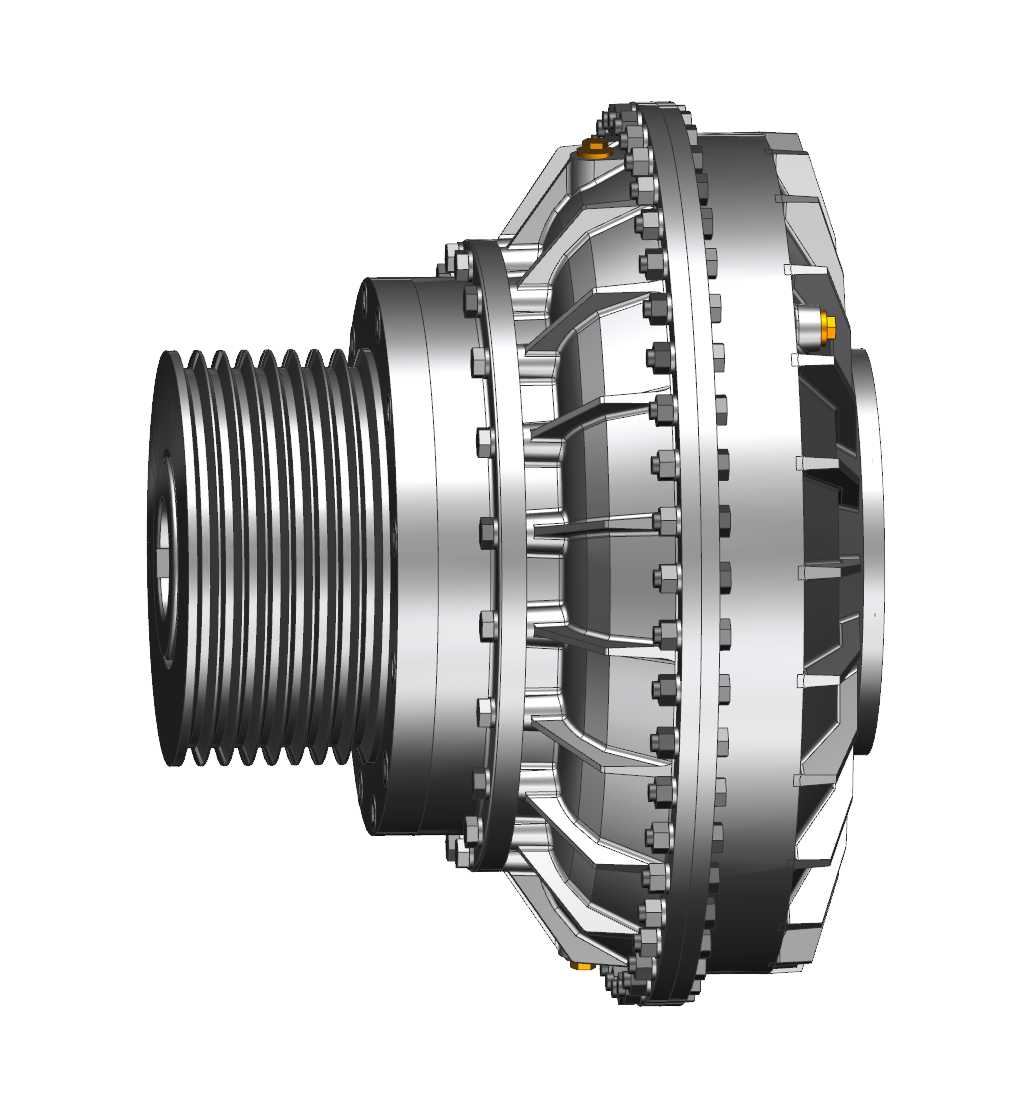
A typical hydraulic coupling consists of three primary parts:
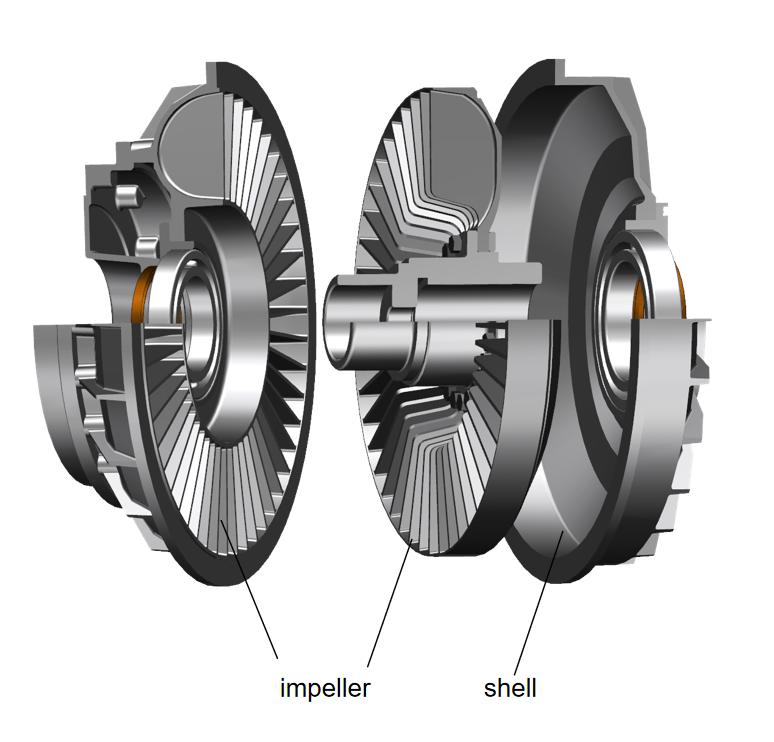
Pump wheel (impeller) – connected to the input shaft (motor or engine). It has radial blades that accelerate the hydraulic fluid outward when rotating.
Turbine – connected to the output shaft (driven machine). It also has blades that receive the fluid flow, converting kinetic energy back into torque.
Hydraulic fluid medium – usually high-grade hydraulic oil or transmission fluid that fills the working chamber. The fluid transfers energy from the pump wheel to the turbine.
Depending on the design, hydraulic couplings can be constant‑fill (fixed oil volume for torque limiting) or controlled‑fill (variable fill for speed control using a scoop tube or external valve).
Working Principle
The operation of a hydraulic coupling follows three distinct stages:
1. Starting Stage
When the motor starts, the pump wheel begins to rotate and pushes the fluid outward from its center. Initially, the fluid flow is weak, so the turbine receives only a small amount of kinetic energy. The turbine starts to rotate slowly, but the coupling transmits limited torque. During this stage, efficiency is low because most of the fluid energy is consumed in accelerating the fluid itself.
2. Acceleration Stage
As motor speed increases, the pump wheel spins faster, generating stronger fluid circulation. More fluid strikes the turbine blades, accelerating the output shaft. The torque transmitted rises progressively, and the coupling efficiency improves. This stage provides a “soft start” – the load accelerates smoothly without mechanical shock.
3. Steady‑State Stage
When the turbine speed approaches the pump wheel speed, the relative slip becomes small (typically 2–5%). The fluid flow reaches a stable equilibrium, and the coupling transmits nearly full torque with minimal loss. At this point, the hydraulic coupling operates at its highest efficiency, providing reliable power transmission with excellent vibration damping.
? Key principle: A hydraulic coupling transfers power hydrodynamically – there is no direct mechanical connection between input and output. This inherent slip gives it natural overload protection: if the load jams, the pump wheel can continue rotating while the turbine stalls, dissipating energy as fluid heat without damaging the motor or machine.
Types of Hydraulic Couplings
Constant‑fill couplings– memiliki volume oli tetap. Pompa ini memberikan karakteristik pembatas torsi tetap dan ideal untuk konveyor sabuk, elevator ember, dan penghancur.
Kopling pengisian terkontrol– memungkinkan level oli diubah selama pengoperasian (menggunakan tabung pengambil atau katup eksternal). Alat ini menawarkan kecepatan keluaran variabel dan digunakan untuk kipas, pompa, dan mesin sentrifugal yang membutuhkan kontrol aliran.
Kopling pengisian tertunda– menggabungkan ruang tambahan yang terisi secara perlahan, memperpanjang waktu soft-start untuk beban dengan inersia sangat tinggi (misalnya, ball mill, konveyor panjang).
Keunggulan Kopling Hidraulik
Variasi kecepatan yang halus dan tanpa ступен– tidak memerlukan kopling atau perpindahan gigi, sehingga menghasilkan pengoperasian yang nyaman dan mengurangi tekanan mekanis.
Mulai dengan lembut– Menghilangkan beban kejut saat motor dinyalakan, melindungi sabuk, rantai, kotak roda gigi, dan bantalan.
Perlindungan terhadap kelebihan beban– ketika mesin yang digerakkan macet atau kelebihan beban, kopling akan selip, membatasi torsi dan mencegah motor mati atau kerusakan peralatan.
Penyerapan getaran dan guncangan– Medium fluida meredam getaran torsi dan gaya benturan dari beban atau motor.
Kapasitas daya angkut tinggi– Kopling hidrolik dapat menangani puncak torsi yang besar dan cocok untuk aplikasi tugas berat seperti konveyor pertambangan, penghancur, dan penggerak kapal.
Perawatan rendah– Tidak adanya kontak mekanis antara bagian penggerak dan bagian yang digerakkan berarti keausan minimal; hanya diperlukan penggantian oli berkala dan pemeriksaan seal.
Aplikasi Umum
Kopling hidrolik banyak digunakan dalam:
Industri pertambangan dan semen (konveyor sabuk, elevator ember, penghancur, penggiling)
Pembangkit listrik (penggiling batu bara, kipas angin, pompa pengumpan boiler)
Penanganan material (penumpuk, pengambil kembali, pembongkar kapal)
Penggerak otomotif dan kelautan (aplikasi terbatas, sebagian besar pada kendaraan berat)
Kipas industri, blower, dan pompa sentrifugal